What’s the Minimum Car Insurance You Need in Florida? 2026 Requirements Explained


Akil Badi is the founder and lead author at PolicyIdea. He writes insurance explainers, policy comparison guides, and consumer-focused finance content.
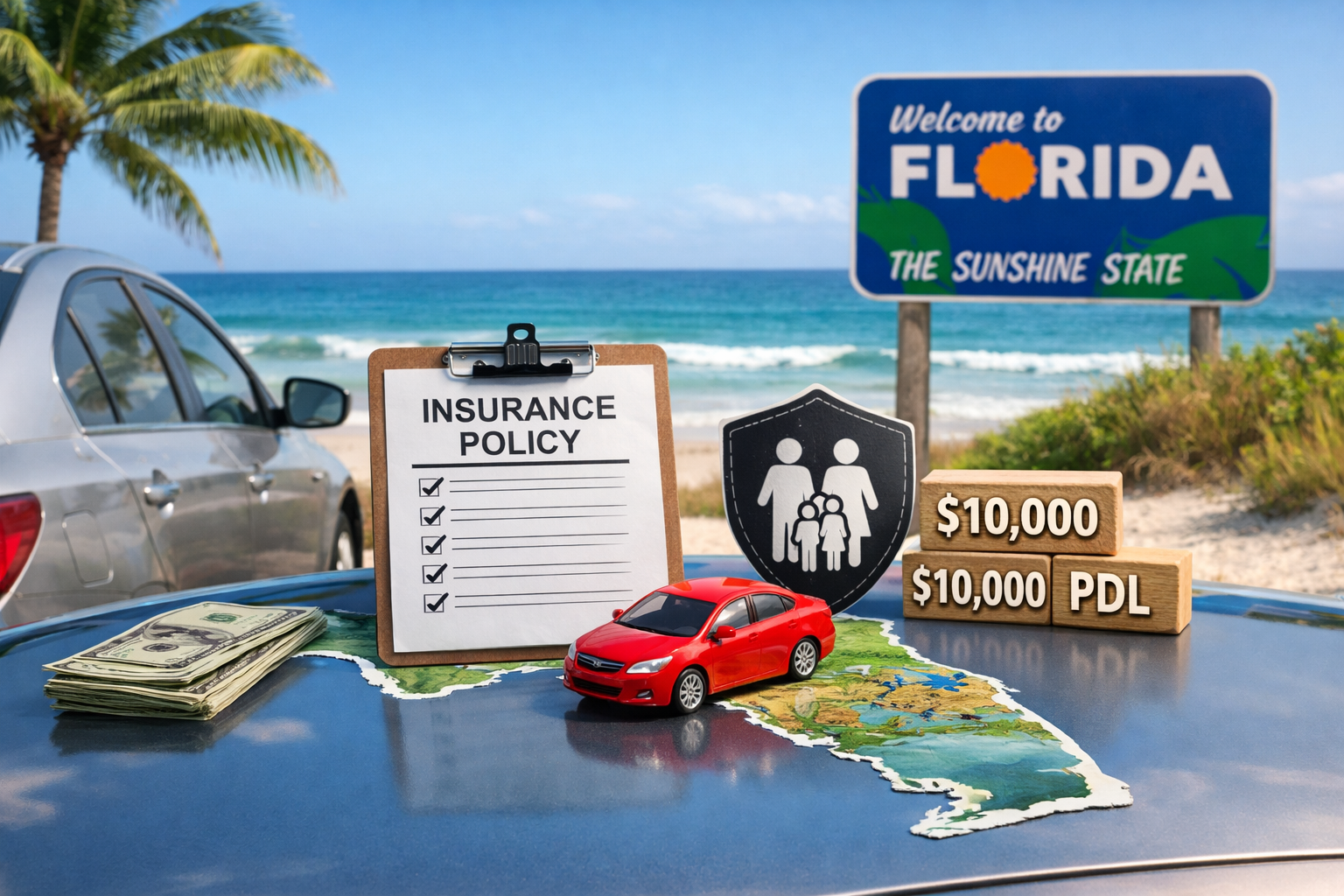
If you want the straight answer without the insurance jargon, here it is: most Florida drivers need $10,000 in PIP and $10,000 in PDL to meet the state’s current minimum requirement. The catch is that the legal minimum and the smart minimum are often two very different things.

If you’re searching for what’s the minimum car insurance you need in Florida, the current legal answer is simple: in most cases, you need $10,000 in Personal Injury Protection (PIP) and $10,000 in Property Damage Liability (PDL).
That is the minimum required to register and keep a four-wheel vehicle insured in Florida right now. But that bare-minimum policy leaves important gaps. It does not automatically give you bodily injury liability, it does not repair your own car after an at-fault crash, and it may not satisfy your lender if your car is financed.
Here is the cleanest way to think about Florida’s current auto insurance minimums for most private passenger drivers.
| Coverage | Minimum amount | Required for most drivers? | What it generally pays for |
|---|---|---|---|
| PIP Personal Injury Protection |
$10,000 | Yes | Your own eligible medical expenses and part of your lost wages, regardless of fault |
| PDL Property Damage Liability |
$10,000 | Yes | Damage you cause to another person’s car or other property |
| BIL / BI Bodily Injury Liability |
Varies | Usually no for basic registration | Injuries or death to other people when you are at fault |
| Collision / Comprehensive | Not set by Florida law | No by state law | Your own vehicle after a crash, theft, weather loss, vandalism, fire, and similar events |
| UM / UIM Uninsured / Underinsured Motorist |
Optional | No | Your injuries when the at-fault driver has no insurance or not enough liability insurance |
Enough to satisfy Florida’s basic requirement for most drivers: PIP + PDL.
Often higher than the legal minimum once you factor in injury risk, vehicle value, loan terms, and how exposed your savings are.
Florida is a no-fault state, which is why PIP sits at the center of the state’s minimum insurance rules. The purpose of PIP is to get some money moving quickly for your own covered injuries after a crash, no matter who caused it.
In plain English: even though PIP is required, it is not unlimited and it is not a full replacement for strong liability coverage or good health insurance. It is best understood as a starting layer of protection, not the whole plan.
Property Damage Liability pays for damage you cause to another person’s property. In a typical accident, that usually means the other driver’s vehicle. It can also apply to things like a fence, mailbox, storefront, telephone pole, gate, or building.
This is one reason the state minimum can feel thinner than people expect. A single newer vehicle can easily exceed $10,000 in damage. If you only carry the legal minimum, you could still be personally responsible for whatever goes over your PDL limit.
For most drivers registering a standard four-wheel vehicle, bodily injury liability is generally not required just to meet Florida’s basic minimum rule. That is one of the most important details people miss when comparing Florida with other states.
But “not required for most drivers” does not mean “never required.” Bodily injury liability can become mandatory in certain situations.
The legal minimum is designed to satisfy the law, not necessarily to protect your budget after a serious crash. That difference matters a lot in Florida.
A helpful way to think about it is this: the state minimum is the ticket to be legal. A stronger policy is the plan to stay financially stable if something goes wrong.
State law and lender rules are two different things. Florida may only require PIP and PDL for most drivers, but your lender or leasing company will often require comprehensive and collision for the life of the loan or lease.
So if you finance your car, the practical answer to “what’s the minimum car insurance you need in Florida?” is usually not just the state minimum. It is the state minimum plus whatever your loan or lease contract requires.
Use this simple guide to see which baseline fits your situation best. This is educational only, not personalized advice.
This is the bare-minimum setup for most Florida drivers who want to meet the law and nothing more. It keeps you legal, but it can leave major out-of-pocket risk after a serious crash.
Florida expects continuous required coverage while the vehicle remains registered. That is true even if the car is not being driven or is temporarily inoperable.
This is one of those small details that saves people from a large administrative headache later.
These are the questions drivers usually ask right after learning Florida’s minimums.
Last updated: March 31, 2026
Reviewed against: official Florida state sources and Florida consumer guidance
This guide is written in plain English for consumers. It is educational content, not legal, financial, or insurance advice. Coverage needs can change based on your vehicle, loan terms, driving history, and personal assets.
Last updated: March 31, 2026
Reviewed by: Akil Badi
Comments are moderated to reduce spam and off-topic submissions.
No approved comments yet. New submissions appear only after moderation.






Community Feedback